


Arab Feminist Civil Society Perspective Regarding States’ Policies on Economic Justice and Rights
December 2020
This session at Global South Women’s Forum 2020 presents two policy papers by the Arab Feminist CSOs Network on the elimination of gender-based violence and economic justice and rights. The papers were developed within the process of preparing for Beijing +25, the Generation Equality Forum 2021 to amplify the voices of civil society and feminist […]
Read More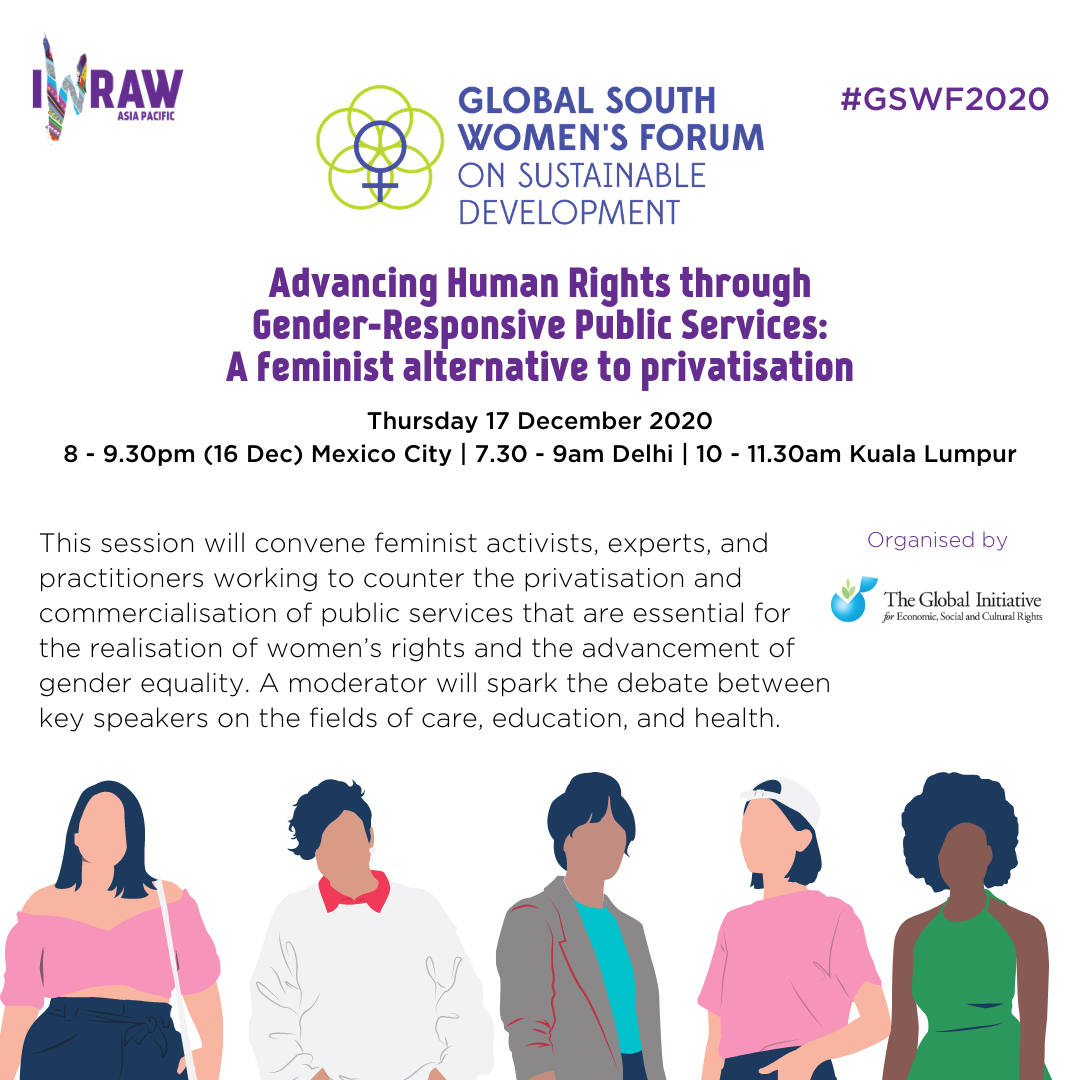
Advancing Human Rights through Gender-Responsive Public Services: A Feminist Alternative to Privatisation
December 2020
This session at Global South Women’s Forum 2020 convenes feminist activists, experts, and practitioners working to counter the privatisation and commercialisation of public services that are essential for the realisation of women’s rights and the advancement of gender equality. Speakers Magdalena Sepúlveda Carmona (GI-ESCR), Kate Donald (Centre for Economic and Social Rights), Verónica Montúfar (Public […]
Read More
Joint Submission to the UN Special Rapporteur on Violence against Women
December 2020
Written together with our partners at Sexual Rights Initiative and the Global Network of Sex Work Projects, this submission focuses on the limitations of a carceral approach to addressing sexual and gender-based violence and the importance of having consent-based frameworks. Word document, seven pages.
Read More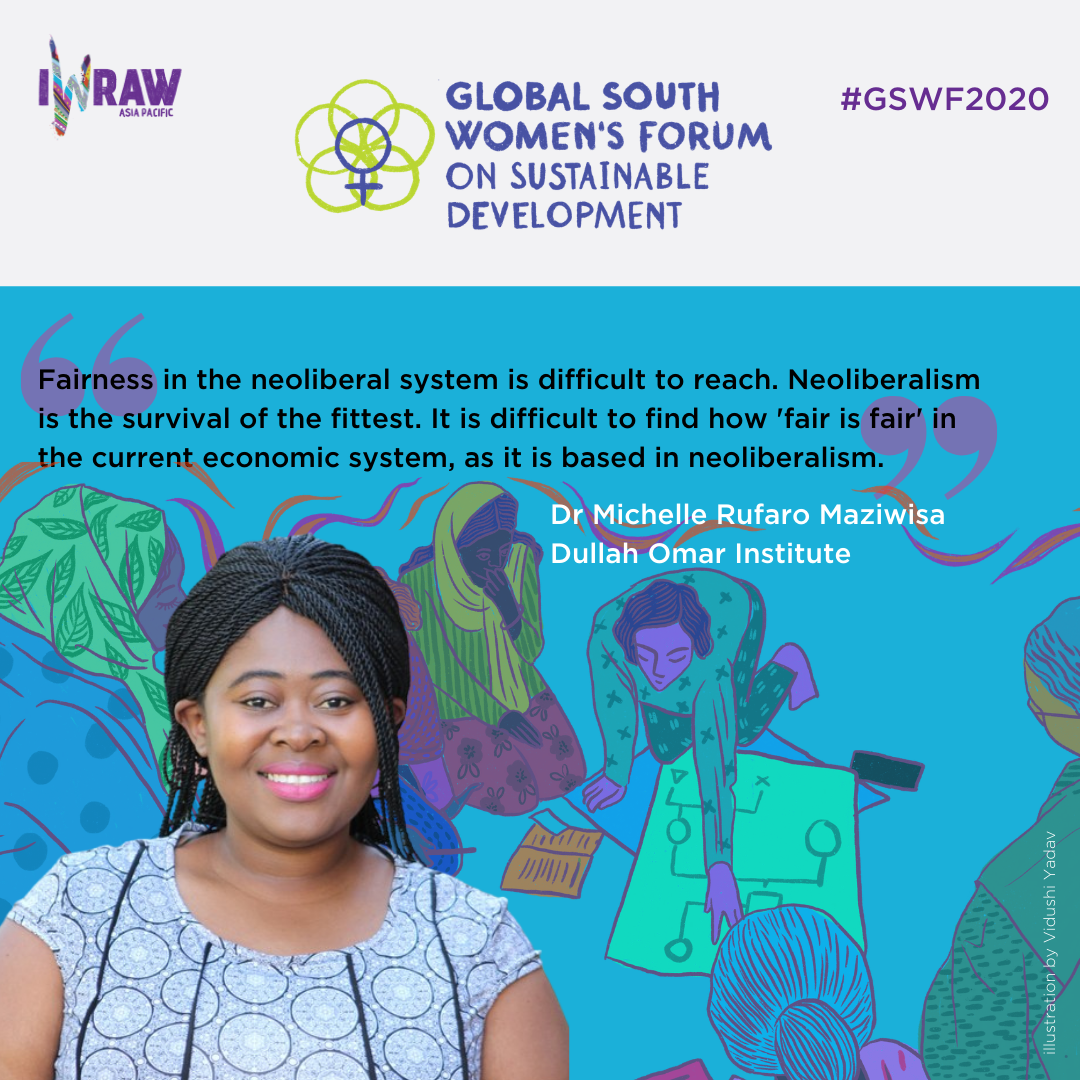
Feminist Engagements with Trade Policy: A Feminist Perspective on Gender Equality and Trade
December 2020
This session, organised by FEMNET at Global South Women’s Forum 2020, explores the question of what feminist trade policy means. It looks specifically at what the AfCFTA is trying to achieve in terms of intra-continental trade expansion and what that means for women beyond gender equality but also in terms of women’s economic rights and […]
Read More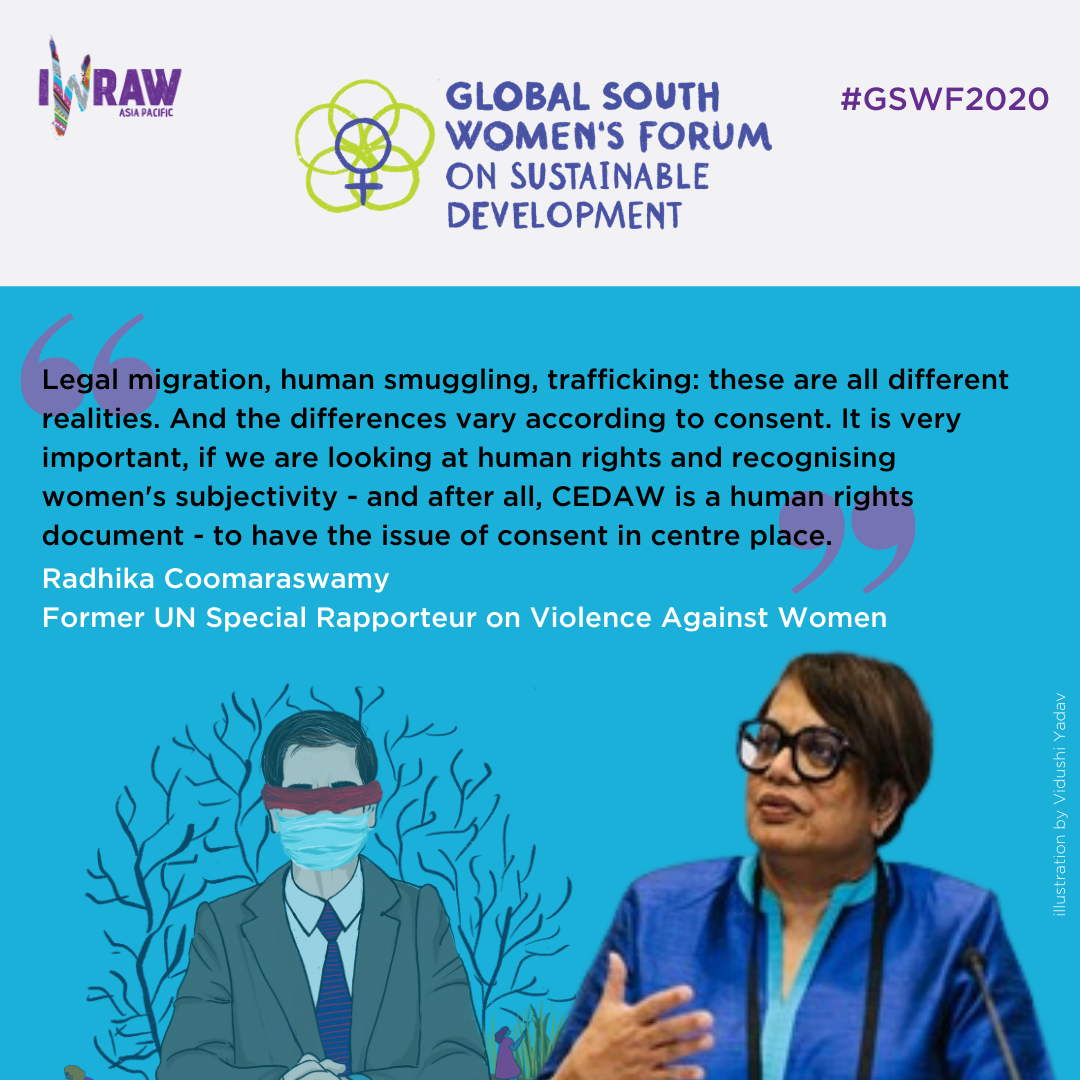
A Feminist Analysis of CEDAW General Recommendation No. 38 on Trafficking in Women & Girls
December 2020
The CEDAW General Recommendation no. 38 on trafficking in women and girls in the context of global migration, adopted in November 2020, recognises that the ‘globally dominant economic policies are the cause behind large-scale economic inequality between States and individuals that manifests as labour exploitation’. It also highlights that macroeconomic factors produce the conditions of […]
Read MoreSorry, no content matched your criteria.